
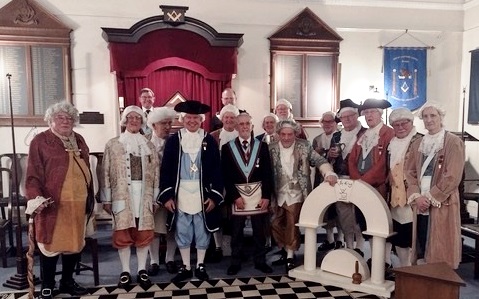
Cornerstone Mark, No. 1992, was pleased to host the SAMMS demonstration team over the border from Somerset. The Somerset Ancient Mark MasterS (SAMMS) team came to exemplify an advancement ceremony from 1795, the details of which had been found in the archives in Bath. The team, led by their ‘Worshipful Sir’ came dressed in period costume, and as the ceremony was probably performed in a tavern, they also came well supplied with tankards of ale or cider. The basics of today’s ceremony was present, but there were some noticeable changes. The Mark ceremony was performed during a Fellow Craft ceremony, the Lodge being opened in the Mark degree, and following the advancement, closed and reopened in the Fellow Craft. The aprons were different, as were the Mark jewels worn by members. The three overseers all sat facing the Worshipful Master, the members always referred to the Worshipful Master as ‘Worshipful Sir’, and the candidate actually constructed an arch, with the keystone being the final stone inserted to make the arch complete. The section with the presentation of the candidate’s hand at the Senior Warden’s wicket is also, clearly, a more modern element added to the ritual.
There were about sixty Mark Master Mason’s present, including members, visitors and the SAMMS team, who sat down for the festive board, where the crossover between 1795 and 2023 continued with the Loyal Toast being to King George lll. It was a fantastic evening, which was enjoyed by all present to witness it. It was a reminder of the longevity of Mark Masonry, but also how it has developed over the past two-hundred and fifty years without losing the core principles of the degree.
Thanks must go to W.Bro. Peter MORGAN and W.Bro. Chris COURT for arranging this meeting (Chris being a member of the SAMMS team and of the Lodge), and to the SAMMS team for giving up their time to visit Uffculme.
The proceeds of the raffle were donated to the SAMMS team to be distributed to their charities in due course. The success of the evening led to several enquires about them visit Devon again soon, so watch this space! Further details of the SAMMS team are available on their website .
Words: W.Bro. Rob Palmer.
Other remarkable events in 1795 were:-
- January – the coldest month ever in the Central England temperature series with an average of −3.1 °C or 26.4 °F.
- 18 January – William V, Prince of Orange, flees the Dutch Republic for exile at Kew.
- 10 to 12 February – great floods on the Rivers Severn and Wye result from ice breakup, snowmelt and heavy rainfall; many bridges damaged.
- March
- "Revolt of the housewives", a series of food riots across England.
- Quota Acts oblige magistrates to find a specified quota of men to serve in the Royal Navy.
- 13–14 March – Battle of Genoa: the British and Neapolitan fleets are victorious over the French. Huzzah!
- April – the British Army is evacuated from Bremen, having been unsuccessful in the Flanders Campaign under Prince Frederick, Duke of York.
- 28 April – Vagrant Act provides for magistrates to enrol vagrants and smugglers into the Royal Navy as an alternative to judicial punishment.
- 5 May – a tax on hair-powder under the Duty on Hair Powder Act 1795 comes into effect, helping to end the fashion for powdering hair and wigs.
- 6 May – introduction of Speenhamland system of outdoor relief for the poor.
- 16–17 June – French Revolutionary Wars: Cornwallis's Retreat – a British Royal Navy battle squadron commanded by William Cornwallis fends off a numerically superior French Navy fleet off the coast of Brittany. Huzzah!
- July to September – a Newcomen atmospheric engine begins pumping at Elsecar New Colliery in the South Yorkshire Coalfield; 220 years later it will be the only operable example on its original site.
- September and October
-
- Riots over shortages of bread in many towns across Britain.
- 29 October – King George pelted with stones by an angry mob as bread riots continue.
- November – Parliament passes the Treasonable Practices Act and the Seditious Meetings Act prohibiting assemblies of more than fifty people.
- 13 December – a meteorite falls at the hamlet of Wold Newton, East Riding of Yorkshire.
Ongoing
- French Revolutionary Wars, First Coalition
Births
- 5 April – Henry Havelock, General (died 1857)
- 25 May – George Meikle Kemp, Architect (died 1844)
- 26 May – Thomas Noon Talfourd, Judge and Author (died 1854)
- 13 June – Thomas Arnold, Historian and Schoolmaster (died 1842)
- 11 August – Elizabeth Sackville-West, Countess De La Warr, Peeress (died 1870)
- 13 September – Julius Hare, Theological writer (died 1855)
- 24 October – Edwin Norris, Philologist, Linguist and Orientalist (died 1872)
- 31 October – John Keats, Poet and leading figure of the Romantic movement (died 1821)
- 10 November – Walter Geikie, Painter (died 1837)
- 10 December – Sir George Burns, 1st Baronet, Shipping magnate (died 1890)
- 4 December – Thomas Carlyle, Historian and Philosopher (died 1881)
- 12 December – Jack Russell, Dog breeder (died 1883)
- Unknown date – Zephaniah Williams, Welsh chartist (died 1874)
Deaths
- 3 January – Josiah Wedgwood, Potter (born 1730)
- 21 January – Samuel Wallis, Explorer (born 1728)
- 9 March – John Walsh, Scientist (born 1726)
- 23 June – James Craig, Scottish architect (born 1744)
- 3 August – Jerry Abershawe, Highwayman (born 1773)
- 1 October – Robert Bakewell, Agriculturalist (born 1725)
- 11 November – George Dixon, Sea Captain and Explorer (born 1748)
(Source: Wikipedia)